DNC2017
SDGs & Multifunctional Land-Use Systems
400+ international experts framing the Nexus Approach against the just-launched Sustainable Development Goals.
17–19 May 2017 · Dresden Congress Centre, Dresden, Germany
Programme
Programme at a Glance
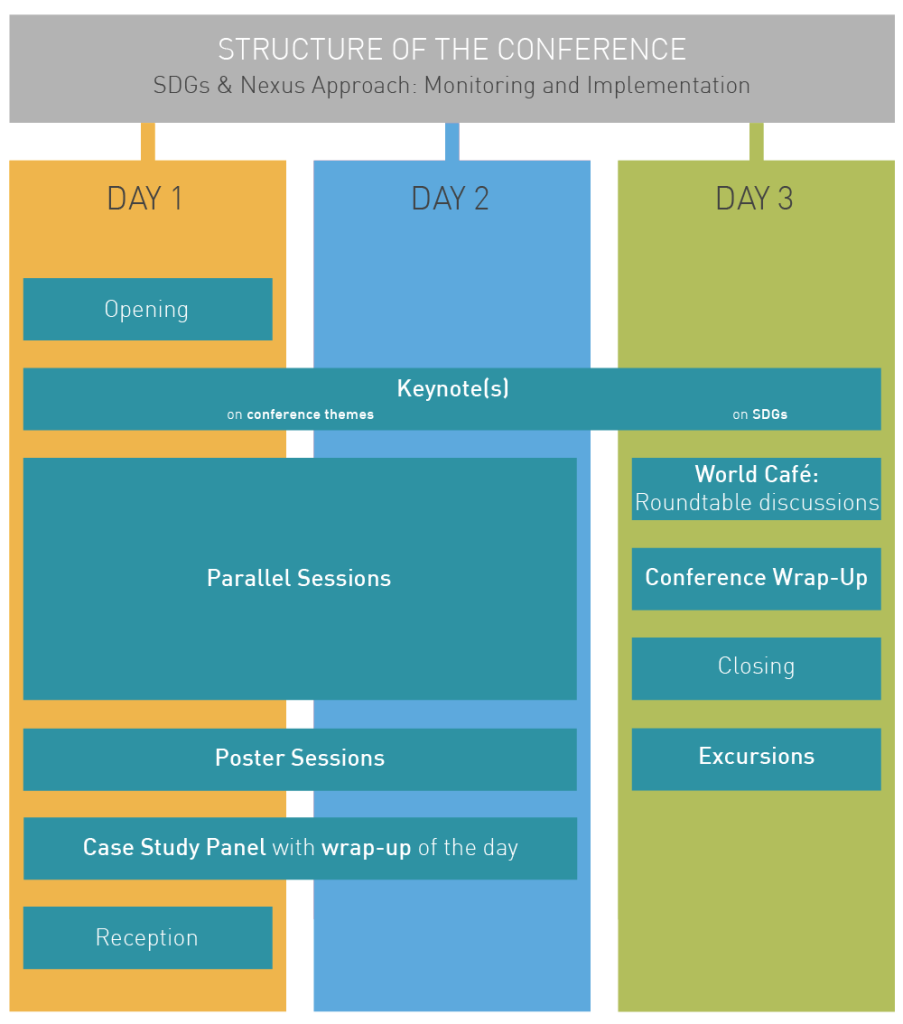
Bringing the right people together and identifying the most important topics of discussion is only half the work in organizing a successful conference. How those discussions are structured will play a crucial role in achieving the desired outcomes. The aim of the organizers is to provide participants the opportunity to engage with the topic of the conference in a structured, innovative and thought-provoking manner. To this end, the Organizers of DNC2017 have prepared a preliminary schedule, based on much deliberation – particularly during the Programme Development Consultation Workshop in November 2015. A variety of both traditional and new session styles are combined in a schedule that ensures a harmonized discussion and synthesis of the daily content – through the keynote speeches and panel discussions on case studies in the plenary sessions. Simultaneously, the proposed schedule offers multiple opportunities for more intimate rigorous discussions in the parallel sessions and the roundtable discussions.
This is the preliminary programme for the main conference, 17–19 May 2017, with a pre-conference day on Tuesday 16 May. Session, speaker and case-study titles link through to their detail pages where available.
Day 1
Wednesday · 17 May 2017
Opening Plenary
Welcome remarks
Uwe Gaul
SMWK · State Secretary
Tania Rödiger-Vorwerk
BMZ · Deputy Director General for Environment and Infrastructure
Frithjof Maennel
BMBF · Deputy Director General for International Cooperation
09:30 – 10:30
Keynotes
Keynote · Resilient Cities
Water Investments: Fundamental Social Means for Adapting to Climate Change and Building Resilience in Our Cities
Keynote · Multifunctional Land-Use Systems
Multifunctional Landscapes: Assessing the Interconnectedness of Water, Food, and Biodiversity
Nicola Fohrer · Institute for Natural Resource Conservation, Christian-Albrechts-Universität zu Kiel
Moderator · Wim van Vierssen, KWR Watercycle Research Institute (CEO)
10:30 – 11:00
Break
11:00 – 12:30
Parallel sessions
A.1
Wastewater Reuse in Nexus Perspective: Environmental, Economic and Societal Opportunities
B.1
Adaptation of Cities to Global Change for Urban Resilience
B.2
Smart Green Cities and the Water-Soil-Waste-Energy Nexus
X.1
Knowledge Management and Transfer for Adoption of a Nexus Approach and Achieving SDGs
12:30 – 14:00
Lunch
14:00 – 15:30
Parallel sessions
A.3
Roles of Multifunctional Reservoirs in the SDG Agenda
A.2
Resource Recovery and Reuse in Multifunctional Land-Use Systems
B.5
Assessing Resilience at the City Level: Methods, Frameworks, Models and Tools
X.2
New and Refined Approaches Supporting the Implementation of a Nexus Approach
15:30 – 16:30
Poster session (coffee break)
on Multifunctional Land-Use Systems
on Resources Management in Resilient Cities
Plenary · Case Studies
Case studies
Regional Climate Change Adaptation Programme for the Dresden Region (REGKLAM) — Christian Korndörfer, City of Dresden
Use of treated wastewater and sewage sludge in Ouardanine — Olfa Mahjoub, INRGREF
Stakeholder Participation and Implementation of Climate Change Adaptation Strategies in Czech Cities — David Vackar, CzechGlobe
Expert commenters
on Monitoring · Rudolph Cleveringa · Global Water Partnership (Executive)
on Implementation · Ruth Erlbeck · Deutsche Gesellschaft für Internationale Zusammenarbeit (GIZ)
Day 2
Thursday · 18 May 2017
Morning Keynote
Keynote · Multifunctional Land-Use Systems
The Importance of Sustainable Soil Management within Multifunctional Land-Use Systems for Achieving the SDGs
Luca Montanarella · Scientific Action Leader, European Commission – Joint Research Centre
Moderator · Rabi Mohtar, Texas A&M University (TEES Endowed Professor)
10:00 – 10:30
Break
10:30 – 12:00
Parallel sessions
A.5
Tools, Data and Instruments for Management of Environmental Resources
A.4
Water and Soil Related Ecosystem Services provided by Forests and Agroforestry Systems
X.3
A Systematic Approach to Map SDG Interactions for Practical Decision-Making
B.4
Nature-Based Solutions for Resilient and Sustainable Cities
12:00 – 13:30
Lunch
13:30 – 15:00
Parallel sessions
A.6
Monitoring and Assessment of Resource Use in Multifunctional Land-Use Systems
X.4
Building-Up Monitoring and Reporting on SDGs based on Sub-National and National Efforts
B.6
Monitoring and Assessment of Resource Use in Resilient Cities
B.3
Water Scarcity and Urbanisation: Integrated Management of Water Supply and Sanitation
15:00 – 16:00
Poster session (coffee break)
on Multifunctional Land-Use Systems
on Resources Management in Resilient Cities
Plenary · Case Studies
Case studies
Large-scale vegetation restoration in the Loess Plateau threatens water security in Northern China — Yanhui Wang, Chinese Academy of Forestry
Management of Mineral Resource Extraction in Hoa Binh Province (MAREX) — Ngo Trung Hai, Vietnam Institute for Urban and Rural Planning (VIUP)
Payment for Ecosystem Services as a Catalyst for Sustainable Land Management in Sasumua Catchment — John M. Gathenya, Jomo Kenyatta University
Expert commenters
on Monitoring · Rattan Lal · Ohio State University
on Implementation · Ania Grobicki · Former Deputy Secretary General, Ramsar Convention
Day 3
Friday · 19 May 2017
Keynotes
Keynote
How to Accelerate Achieving SDGs? The Need for Integrated Analysis and Synthesis Across the 2030 Agenda
Keynote
Key Strategies to Achieve the SDGs and Consequences for Monitoring Resource Use
Stefan Bringezu · Center for Environmental Systems Research (CESR)
Moderator · H.E. Ambassador Csaba Kőrösi, Office of the President of the Republic of Hungary (Director)
10:00 – 11:00
World Café
11:00 – 11:30
Break
11:30 – 12:30
Conference Wrap-Up
Panel
János Bogárdi
University of Bonn · DNC2017 ISAC Co-Chair (Key Listener)
H.E. Ambassador Csaba Kőrösi
Office of the President of the Republic of Hungary · Director
Birguy Lamizana-Diallo
UN Environment · DNC2017 ISAC Co-Chair
Kwang Kook Park
Korea Environment Institute · President
Moderator · Reza Ardakanian, United Nations University (UNU-FLORES)
12:30 – 13:00
Closing
Jacob Rhyner
UNU · Vice-Rector in Europe
Hans Georg Krauthäuser
TU Dresden · Vice-Rector for Academic and International Affairs
Bernhard Müller
IOER · Director
13:00 – 14:00
Lunch
from 14:00
Excursions
Excursions
A
Post-mining area of the Upper Lusatian Region, Germany
B
Waste Water Treatment Plant, Sewage Purification and Sludge Processing (Dresden-Kaditz)
C
Flood Pumping Station and Stormwater Overflow Tank (Dresden – Johannstadt)
D
Weißeritz Green Belt (Dresden – Plauen)
Dresden Nexus Conference 2017
Explore this edition